

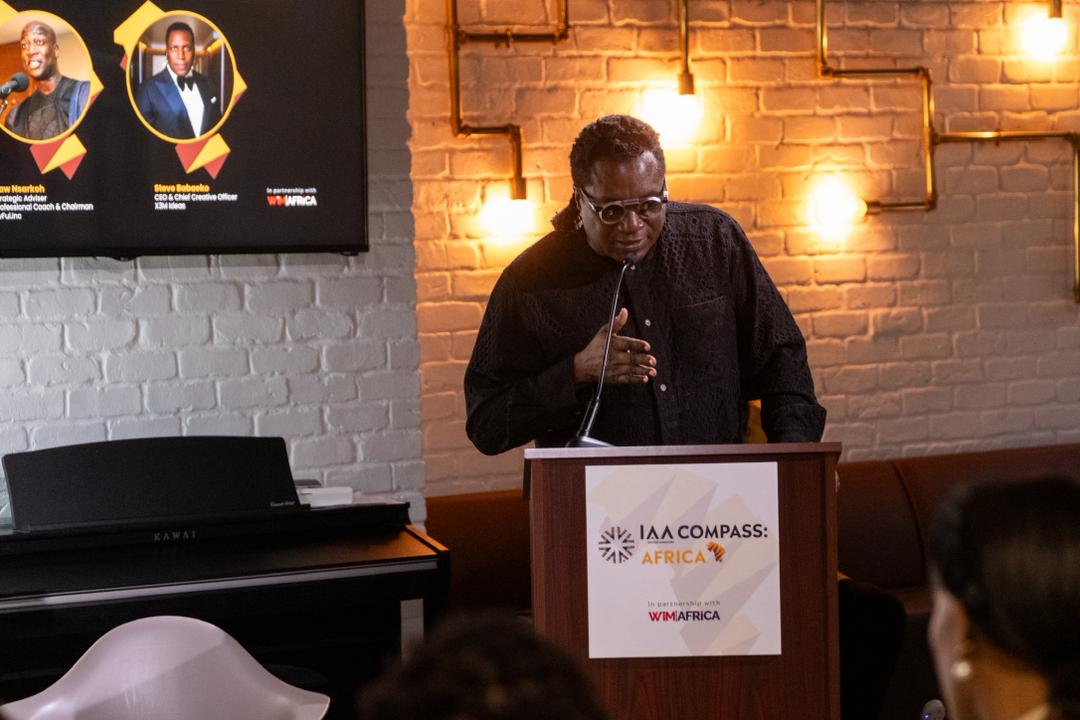
At the IAA Compass Africa conference held on March 12, 2026, at Fordham University in London, Steve Babaeko delivered a speech that challenged long held assumptions about the UK Africa relationship, urging a decisive shift from legacy thinking to future focused partnership.
Speaking as President of IAA Nigeria and Director of IAA Africa under the International Advertising Association, Babaeko anchored his message not in abstract theory, but in lived industry experience.
He opened with a personal reflection that set the tone for the session.
“The first time I saw a Nigerian campaign travel beyond our borders,” he said, “I realized something powerful; we were not just creating ads; we were exporting identity.”
That moment, he explained, was more than professional validation. It was a window into a broader transformation already underway, one that extends beyond advertising into culture, economics, and geopolitics.
Moving Beyond the Language of the Past
Babaeko was direct in his critique of how UK Africa relations are often framed.
Too frequently, he noted, the conversation defaults to terms such as empire, aid, and dependency; language that, while historically grounded, risks anchoring the relationship in outdated assumptions.
“That is the wrong frame,” he told the audience. “The UK Africa connection today is not just about history. It is about relevance, opportunity, and shared future.”
While acknowledging the complexities of that history, including colonial legacies and structural imbalances, he argued that mature partnerships are built not on denial or sentiment, but on clarity and intentional progress.
Culture as the Bridge
From history, Babaeko pivoted to culture, highlighting it as the most powerful and often underestimated connector between the UK and Africa.
He pointed to the global rise of Afrobeats as a case study in how collaboration, rather than hierarchy, drives influence. Long before the genre achieved global dominance, he noted, the UK played a critical role in its development through diaspora communities, radio platforms, and live performance circuits.
“Culture goes where policy cannot,” he said. “It builds familiarity before agreements are signed. It humanises markets.”
In Afrobeats, Babaeko sees more than a musical success story. He sees a working model for the future African creativity meeting British infrastructure; local stories achieving global reach through shared platforms.
This dynamic, he argued, is not limited to music. It is visible across film, fashion, literature, and digital culture particularly among younger generations navigating hybrid identities across both regions.
The Economic Imperative
If culture explains the connection, economics, Babaeko argued, makes it urgent.
He described Africa not as a development challenge, but as a growth frontier home to one of the youngest and fastest growing populations in the world. With this demographic shift comes a surge in consumers, entrepreneurs, and creators shaping new markets.
For the UK, he stressed, this is not a matter of charity, but of strategic relevance.
Citing growing trade volumes between the UK and Nigeria, Babaeko pointed to a broader shift in engagement from donor recipient dynamics to investment driven partnerships.
“Words reveal mindset,” he said. “And mindset shapes policy.”
Rewriting the Script
At the heart of Babaeko’s address was a call to fundamentally rethink the structure of the relationship.
“The old script says the UK gives and Africa receives,” he said. “The new script must say: we build together.”
That shift, he emphasized, requires more than rhetoric. It demands tangible changes, fairer trade systems, deeper investment in African enterprise, support for creative industries, and greater mobility of talent and ideas.
Partnership, he noted, does not ignore existing imbalances. It confronts them and then designs better systems around them.
A Defining Moment
Framing his remarks within a broader global context, Babaeko pointed to a world in transition where alliances are shifting, supply chains are being redefined, and influence is increasingly distributed.
“In such a world, no serious country can afford to misunderstand Africa,” he said. “And no serious African nation should accept being treated as an afterthought.”
As Nigeria approaches the centenary of formal advertising practice in 2028, Babaeko closed on a symbolic note; highlighting the opportunity to redefine long standing connections.
“A century ago, commercial links helped shape one of Nigeria’s most important industries,” he said. “A hundred years later, we have the chance to redefine what those links mean not as remnants of empire, but as instruments of mutual growth.”
His message was clear the UK Africa relationship is no longer a question of history alone. It is a test of imagination, strategy, and the willingness to build something equal.
And, as Babaeko suggested, that future may already be closer than many think.